
The Decisive Front: How Relentless Focus Drives Growth
Why keeping your options open is the surest path to failure

Wars are not won by evacuations.” — George Marshall, 1940
Exclaimed General George Marshall to Winston Churchill at the lowest moment of the Allied war effort, just after Dunkirk had happened.
330,000 British troops were pulled off the beaches of France, and they were celebrated at home as a miracle, but Marshall saw it for what it meant strategically, a retreat dressed up as a victory.
Marshall understood something Churchill kept resisting: you do not win wars by surviving them. You win wars by concentrating overwhelming force on the one front that ends them.
He would spend the next four years fighting for that principle in every Allied strategy session, and the argument he won is the reason you’re reading this in English.
Who was George Marshall?
If the name doesn’t stop you the way Eisenhower or Patton does, that’s by design.
George Catlett Marshall was the U.S. Army Chief of Staff from 1939 to 1945. He was the architect of the largest military force ever assembled. He built it from 189,000 soldiers to over eight million. He selected the generals who led it, designed the strategy that guided it, and held the Allied coalition together when it threatened to fracture.
Winston Churchill called him “the greatest man he had ever met.”
After the war, Marshall served as Secretary of State and designed the Marshall Plan. He is the only professional soldier in history to receive the Nobel Peace Prize.
He is not a household name to many. He spent his entire career making sure the credit went to someone else.That, too, was part of the principle.
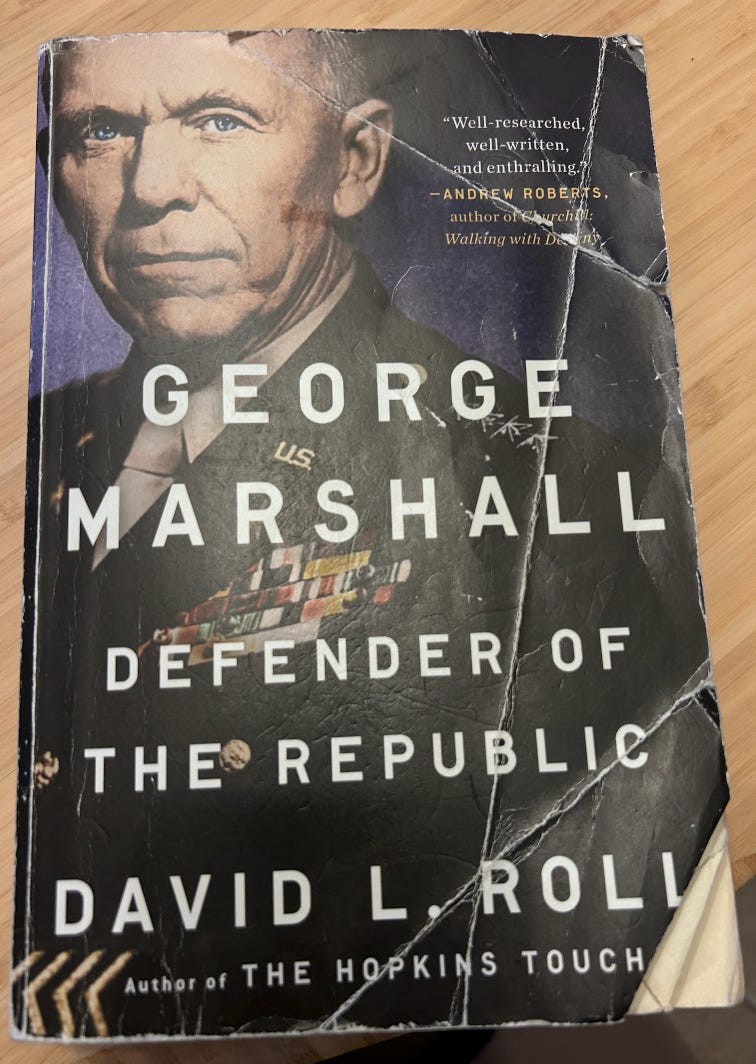
In his essential biography George Marshall: Defender of the Republic, David Roll traces the through-line of Marshall’s life and leadership. He is a man whose defining conviction was that the greatest danger to any fighting force isn’t the enemy in front of you. It’s the dispersion of your own energy across too many fronts.
The greatest danger to any fighting force isn’t the enemy in front of you. It’s the dispersion of your own energy across too many fronts.
The argument he kept losing
From 1941 through 1944, Marshall fought the same strategic battle on repeat, to no avail. Churchill wanted flexibility.
North Africa. Italy. The Aegean. Anywhere the Allies could probe and pressure without committing fully.
Churchill’s instinct was to keep forces moving, maintain flexibility, and avoid the danger of a single decisive battle that could lose the war. However, the issue with this approach, whether in war or business, is that without strategic focus and commitment, you might not lose, but you're unlikely to win.
For Marshall, the objective was to win the war, not to extend the struggle.
“Marshall and most military strategists at the time regarded as an essential condition of success in war — concentration of effort on the decisive front.”
He lost the argument more than once. North Africa happened. Italy happened. Each time, the decisive front got delayed. And each time it got delayed, the war lasted longer.
When the Allies fully and decisively committed to Operation Overlord in June 1944, the European war concluded within a year. Although the principle was eventually secured, it took three years of Marshall's persistent refusal to abandon it before it was achieved.
What he learned from Pershing
The conviction didn’t come from nowhere.
Marshall had served under General Pershing in WWI and absorbed a lesson that shaped everything that followed. Pershing had fought the same political battle against allied commanders who wanted American troops parceled out across French and British units rather than concentrated as an independent force.
Pershing resisted. Marshall watched. And what Marshall took from it wasn’t just tactical, it was philosophical.
“From Pershing, Marshall also learned that in an allied coalition one should strive to minimize the dispersion of forces to other fronts and instead concentrate overwhelming power against the enemy.”
Minimize dispersion. Concentrate overwhelming power.
He carried that sentence into every room he entered for the rest of his career.
The cost of being right
The hardest part of Marshall’s story isn’t that he fought for concentration. It’s what it cost him personally.
He had advocated for the Normandy invasion for nearly two years. He believed in it completely. Pershing had recommended him for a star after WWI. He had spent thirty-seven years preparing for exactly this kind of command.
And when Roosevelt asked him whether he wanted to lead Operation Overlord — the invasion he had designed, argued for, and refused to abandon — Marshall declined to express a preference.
He told the president to make whatever decision was best for the country, and not to consider his feelings.
The command went to Eisenhower.
“It required extraordinary moral discipline — strength of character — for Marshall to refrain from asking FDR for the command when he knew it would be granted.”
He never complained. Never made his feelings known. The principle mattered more than the recognition.
That, too, is part of what concentration requires. You don’t get to fight on every front.
How does this essay relate to growing durable businesses?
I’ve spent the better part of ten years inside GTM orgs at every stage of growth.
The recurring issue I observe isn’t related to poor reps, weak pipelines, or incorrect CRM choices. Instead, it's dispersion: pursuing three ICPs simultaneously, juggling five incomplete initiatives, and distributing energy across numerous urgent opportunities. This scatter prevents any one effort from gaining the momentum necessary to close successfully.
Marshall would recognize it immediately.
The founders and CEOs I collaborate with aren’t failing due to a lack of effort. Their setbacks stem from not choosing the right front to focus on.
That’s what this newsletter is for.
Join 2,100 founders and operators who read the Decisive Front every Saturday. One short essay on concentrating overwhelming force on the one front that can drive durable growth, in business and life.
This is The Decisive Front.
Welcome.
— Ben
Pamela - I’m so grateful to hear that. What specifically stood out to you?
Excellent. In one essay, you solved an issue that's been plaguing me. Thank you.